Course III
Mary, Untier of Knots
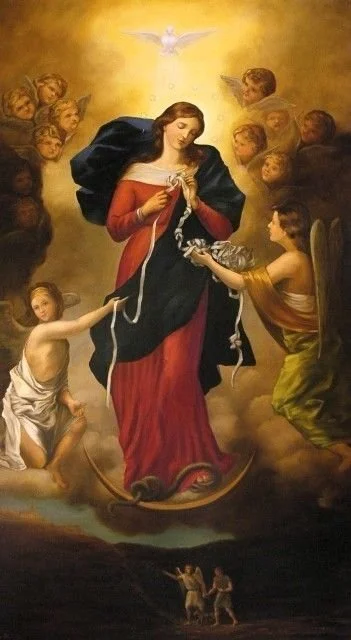
The painting Mary, Untier of Knots by Johann Schmidtner (1625–1707), presents a simple but powerful image. Mary patiently untying the knots of a long ribbon, the kind that seem impossible to loosen on our own. At the bottom a small figure is led forward by an angel a reminder that even in confusion or struggle we are not left alone. The message is clear, what is tangled in our lives God through Mary’s intercession can restore. This idea goes back to Irenaeus of Lyons, who was born in the year 125, but we have his writings still today. He wrote, “that the knot of Eve’s disobedience was loosed by the obedience of Mary. Where Eve’s no, bound humanity, Mary’s yes, began to set it free.
Mary’s role in the faith is not distant or symbolic. She is the one who said yes without fully knowing the cost who carried Christ into the world and who stood faithfully at the foot of the Cross, when all but a few deserted. She shows us what it means to trust God completely. As we remember from the Fall, at the heart was a lack of trust from Adam and Eve, but it is Mary, that being Full of Grace, also fully trusted in God. That trust extends in times of uncertainty and suffering. When Jesus in His final moments on the Cross, turns to John and says, “Behold your mother.” He is speaking to him but not only to him. In that moment He is speaking to all believers. She is not just the mother of Christ. She is our mother.
We do not worship Mary. She is not a goddess. But she holds a unique place in salvation history because she bore God Himself. This is why the early Church fiercely defended the title Theotokos meaning ‘God bearer’ at the Council of Ephesus. This was not just about Mary it was about protecting the truth of who Jesus is fully God and fully man. To call Mary Theotokos is to proclaim that the child she carried is truly God. We honor her, we venerate her, and we ask for her intercession not because she replaces God but because she leads us to Him. At the Wedding Feast at Cana, it was the intercession of Mary to Jesus, that instigated the first miracle, alerting “They do not have anymore wine.” She was the bridge between the wedding party and Jesus’ divine nature. And it was Mary, realizing that Jesus was going to step in and act, that then turned and said to the servants "Do whatever he tells you." We are now those servants. In that way Mary, is like asking a close friend to pray for you except Mary is closer to Jesus than anyone. As St. Maximilian Kolbe stated, "You can never love her more than Jesus did.” The key distinction is: worship is reserved for God alone, high veneration (deep respect) is given to Mary.
As Fulton Sheen said, Mary is like the moon. She has no light of her own but reflects the light of the sun. In other words, Mary has no divine power of her own and only reflects the light, the divine power of her Son, Jesus Christ. Everything about her, points beyond herself to Christ. And her role did not end in the Gospels. Throughout history Mary has continued to appear in quiet but powerful ways at places like Lourdes, Guadalupe, and Fatima. Places that draw more visitors of the faithful than any other on the planet. These apparitions are not required belief but they echo the same message she has always given Do whatever He tells you. As Mary, does not seek to draw attention to herself but to call people back to prayer, repentance, and most importantly, her Son
To understand Mary even more deeply we can look at the world she came from. In his work on the Jewish roots of Mary, Brant Pitre, shows how the Old Testament prepares us for her role. Just as the Ark of the Covenant carried the presence of God, Mary becomes the living Ark who carried God Himself into the world. What once was a sacred object, becomes a person. If you recall, the Ark of the Covenant sat in the center of the Temple, where Heaven and Earth met. And now in Mary the living Temple, Jesus Christ is that meeting point. This Ark initiates the story of our redemption.
In Mary’s Magnificat, or My soul magnifies the Lord, it is believed to be a hymn spoken or sung first by Mary to her cousin Elizabeth upon visiting her after the angel Gabriel broke into her humble world. It was burst out of Joy and excitement, and decades later recorded in Luke’s Gospel account. You can imagine Luke, a detailed, brilliant Physician, sitting down at a table with Mary many years later and the awe he must have felt recording these words from Jesus’s mother. Our Mother. The Mother of God. Theotokos
My soul magnifies the Lord,
and my spirit rejoices in God my Savior,
for God has looked with favor on the lowliness of the Almighty’s servant.
Surely, from now on all generations will call me blessed;
for the Mighty One has done great things for me,
and holy is God’s name.
God’s mercy is for those who fear God
from generation to generation.
God has shown strength with God’s arm;
God has scattered the proud in the thoughts of their hearts.
God has brought down the powerful from their thrones,
and lifted up the lowly;
God has filled the hungry with good things,
and sent the rich away empty.
God has helped servant Israel,
in remembrance of God’s mercy,
according to the promise God made to our ancestors,
to Abraham and to his descendants forever.