Course III
Christians were a problem
The message of Jesus was spreading, and with it came a disruption to everything the Roman world was built on. Christians were no longer honoring the Roman gods, no longer attending the festivals, no longer giving the emperor the reverence expected of him. To say “Christ is Lord” was not a spiritual statement, it was a direct challenge. Because the prevailing claim of the time was simple, “Caesar is Lord.” And no one threatens Caesar. This had to be dealt with.
The same fear that once gripped King Herod, the fear of a rival king rising from Judea, had now shifted to the Roman emperors. Only now it was worse. Because Jesus had already been executed… and yet His movement was growing. Christians were not fading away. They were multiplying. And so the most powerful men in the world made the same fatal calculation again and again, round them up, execute their leaders, crush the movement. But every time they tried, something unexpected happened. From the rubble, new voices would rise and proclaim again, “Christ is Lord.”
This is where we get the word martyr, from the Greek martys, meaning witness. These were men and women who didn’t just believe, they testified with their lives. The Apostles, former fishermen, tax collectors, even persecutors of Christians now turned believers, were dragged into public squares, displayed at festivals, and executed as a warning. Stop. Be silent. Deny Him.
Emperor Nero, after the great fire of Rome led the persecutions that crucified Peter upside down and beheaded Paul. Peter was dumped and later buried by Christians at a vacant hill used for dumping garbage, Vatican Hill. Almost all the apostles share a similar fate in various horrible deaths. It was meant to end the story.
If you ever wrestle with moments of doubt, it’s worth asking a simple question. Would you be willing to die for something you knew was made up? All they had to do was say, “It didn’t happen.” And they lived. But they didn’t. They proclaimed boldly, Anástasis. Resurrection.
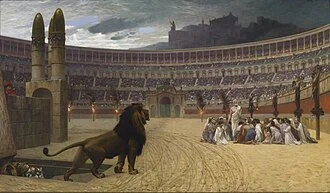
These martyrs became something more than victims. They became a kind of compass, pointing future believers toward courage. A reminder of what it means to say Jesus Christ is Lord, not just with words, but with your life. Then came the year 303, and the emperor at the time Diocletian. He was going to end it. The harshest persecutions the Church had ever seen were unleashed. Scriptures burned, churches destroyed, Christians imprisoned, tortured, executed. In the Colosseum, captured Christians huddled together in the Colosseum dirt floor as hungry lions were released from underground. Unbelievable cruelty. The Roman empire saw this as the end.
You’re a Roman citizen. You believe in Jesus Christ. And you need to get to Mass. There are no church buildings. No bells calling you in. No public gatherings. You don’t tell people where you’re going, maybe not even your closest friends. You move quietly through narrow streets, slipping into a hidden home, or descending into the catacombs, underground burial sites beneath the city of Rome. And there, surrounded by buried martyrs, the Church gathers. Mass is celebrated in the presence of those who gave everything. This is the origin of the Church. And still, they gathered. They celebrated the Eucharist. They prayed. And the Church continued to grow. Why? Because courage is contagious.
Then something no one saw coming. In the year 313, under the emperor Constantine, Christianity was legalized. The persecutions stopped. People once hunted… were now free. And it spread. Christianity moved rapidly across the empire, into cities, into homes, into the farthest reaches of the known world. What emperors tried to crush became unstoppable. The faith was no longer surviving. Against all odds. It was rising.
Going back to where it began, after the execution of Peter and Paul, that same Emperor Nero in 68 AD built a Statue of himself over one hundred feet tall, a bronze statue representing himself as the Sun God, “Colossus Nero,” it was called. It depicted him on top the world. It would last only a few decades before being torn down. Two to three miles away however, the burial place of Peter, St. Peter’s Basilica remains.