Course III
One of the most beautiful lines we say every Sunday in the Nicene Creed is this:
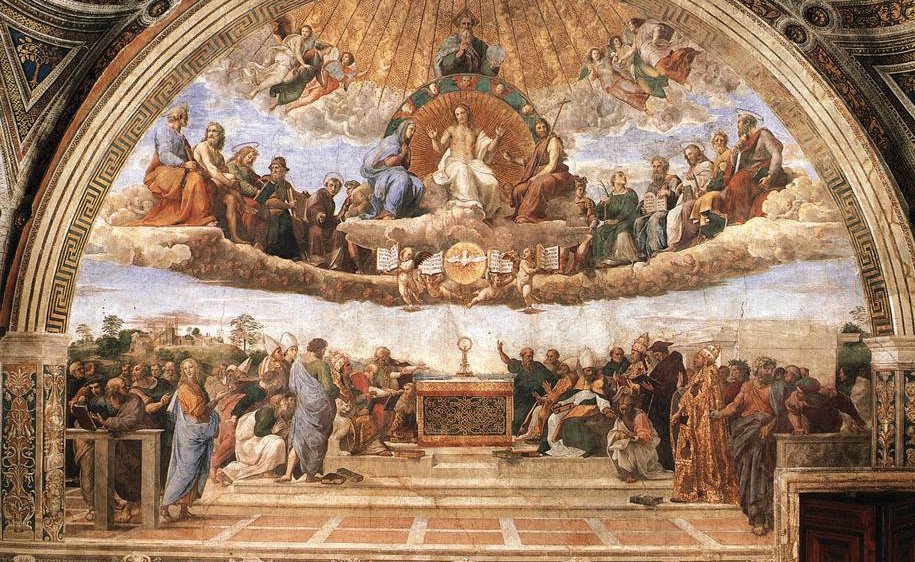
“I believe in the communion of saints.” But what does that actually mean? It means that the Church is bigger than what we see. Christianity has never been just the people in this room… or just the people alive today. The Church stretches across time and eternity. The Church calls this the Communion of Saints, that we are one body, across heaven and earth. It includes the faithful on earth, the souls being purified, and the saints already in heaven with God. It is one family. From the very beginning, Christianity was lived this way. When the early Christians gathered for the Mass, they believed heaven and earth were united. They believed they were worshiping with the angels and the saints. This belief goes all the way back to the earliest days of the Church.
When the earliest Christians celebrated Mass in underground burial places, called the catacombs, there they worshiped surrounded by tombs of martyrs. They did this for safety at times to a degree, but also because they believed those martyrs were not gone. They were alive in Christ. The Church had not lost them. They had simply gone ahead. Think about that for a moment. When a Christian dies in Christ, death does not break the family of God. It strengthens it. Those who have gone before us are now closer to God than we are. And because they love us, they pray for us. This is why Christians have asked the saints for prayers for nearly 2,000 years. Just like you might ask a friend to pray for you. They difference is, they see Him face to face. From the early Church to modern times, the saints illuminate the path of faith for all believers.
St. Francis of Assisi born into a wealthy family embraced radical simplicity and care for creation, teaching that living in humility and love can reveal God’s presence in the world around us.
St. Joan of Arc, guided by divine visions, courageously led her people and remained steadfast in faith, reminding us that God can call anyone, even the young, to extraordinary acts of courage and devotion.
St. Teresa of Avila opened the soul to the depths of prayer, illustrating that intimate union with God transforms ordinary life into a sacred journey.
Karol Wojtyla, lived under German occupation during World War II and attended seminarian school under the cover of darkness. In fact, they would meet at times underground, and had to have felt like the early Christians that Emperor Nero and Emperor Diocletian tried so desperately to stomp out. Although, like those early Christians, Karol would continue his studies under harsh war and oppression and unimaginably rose to eventually become Pope John Paul II and now St. John Paul II. He would later hold a World Youth Day and now in front of hundreds of thousands proclaim to the masses:
“Do not be afraid. Do not be satisfied with mediocrity. Put out into the deep and let down your nets for a catch…. I plead with you--never, ever give up on hope, never doubt, never tire, and never become discouraged. Be not afraid.”
Then there is Francis Gajowniczek, Francis, is not a canonized Saint. He instead got to live a full life however, dying at the age of 93 in 1995 surrounded by family and loved ones. His life was on the brink of coming to an end much sooner in the most horrific of ways. Francis was a prisoner of a WWII concentration camp and when a camp prisoner escaped, The German captain ordered that ten other prisoners be executed. Francis Gajowniczek (prisoner number 5659) was one of those selected at roll call to die. When priest Maximilian Kolbe heard Gajowniczek cry out in agony over the fate, and the loss of ever reuniting with his family, Maximilian Kolbe offered himself instead.
St. Maximilian Kolbe died in Gajowniczek’s place. There is no greater love than this. St. Kolbe reminds us that courage and self-sacrifice can shine even in the worst darkness. These Saints lived in different centuries. Different countries. Different cultures. The saints are not superheroes. They were human. They struggled. Some doubted. Some failed. Some started far from God. But they said yes to Him. And over time, His grace changed them.
And that is the way Grace works. It is a word you hear often, but we should define further what it means. Grace is the unearned gift poured out for us, drawing us to Himself. Being open to God’s will allows us to receive that Grace receptive, and willing to cooperate. If I could use a modern example, God’s grace is like a powerful Wi-Fi signal always available, connecting us to the source of truth and love. Our free will is like the wireless router: it must be turned on and set to receive. Without our openness, the signal is present, but we remain disconnected. When we cooperate, grace flows into our lives, transforming us from the inside out. When you receive that signal clearly, you move. It created action and desire. In G.K. Chesterton’s words: “Joan of Arc was not stuck at the cross-roads, either by rejecting all the paths like Tolstoy or by accepting them all like Nietzsche. She chose a path, and went down it like a thunderbolt.”
The saints are proof that holiness is possible. And here’s the most important part: The Communion of Saints is not just about the past. It includes us. Every baptized Christian is called to holiness. The saints are not a special class of Christians. They are what Christianity is supposed to produce. Which means the story of the saints is still being written. Right now. In this generation. There’s another dimension of prayer that we don’t talk about enough, but it reveals just how powerful love really is. In the Catholic faith, we don’t just pray for the people in front of us, or even just for ourselves, we also pray for those who have gone before us. I remember my dad used to say something simple, “offer it up for the souls in purgatory.” And as a kid, I didn’t fully understand what he meant, but I knew it mattered. The Church teaches about Purgatory, not as a place of fear, but as a place of mercy, a place of preparation where souls are being made ready for the fullness of heaven. It’s not a second chance, it’s the final healing. And here’s what’s incredible, our prayers can actually help them. Think about that. Love doesn’t stop at death. Prayer doesn’t stop at death. We are still connected. When we pray for those who have passed, when we offer a Mass, when we make a sacrifice and say, “Lord, use this for them,” we are participating in something far bigger than ourselves. Communion of Saints means that your prayer today can bring grace to someone you may never meet until heaven.
And maybe it’s a loved one, a parent, a grandparent, a friend, or maybe it’s someone forgotten by the world. The ultimate pay it forward. No one is forgotten by God, and through prayer, no one has to be forgotten by us either. So when you pray, don’t just pray for what you need. Expand it. Offer it. Your struggles, your sacrifices, even your small inconveniences, they can become acts of love for someone else’s eternity. The saints are not distant figures in stained glass. They are older brothers and sisters in the faith. They cheer us on. They pray for us. And they remind us that following Christ is worth everything. Because they reached the destination. They are home. And they want us to get there too.
Remember that you will derive strength by reflecting that the saints yearn for you to join their ranks
Henry Suso – 14th Century