Course II
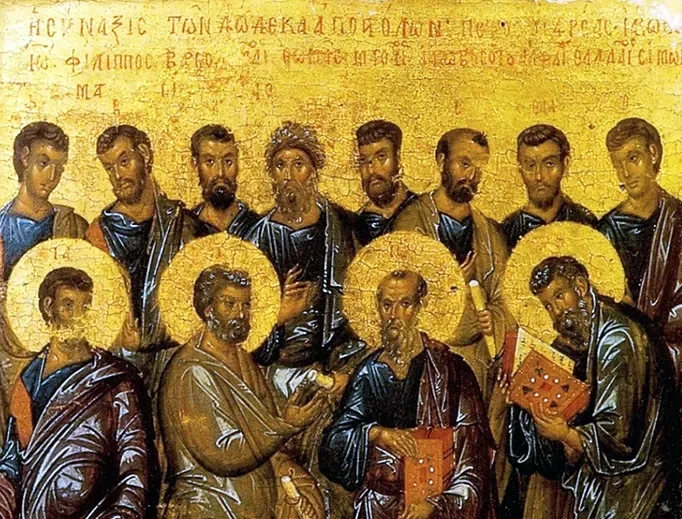
If you could gather twelve people to change the world, who would you choose?
Would you choose the brilliant? The powerful? The accomplished? Jesus’ choice was startling in its simplicity. Fishermen. A tax collector. Ordinary men. Each willing to follow. They were unremarkable by the world’s standards. Yet through their obedience, the world itself was transformed.
As he was walking by the Sea of Galilee, he saw two brothers, Simon who is called Peter, and his brother Andrew, casting a net into the sea;
they were fishermen. He said to them
“Come after me, and I will make you fishers of men.”
Matthew 4
Then, there is the surprising call of Matthew the Apostle. Matthew was a tax collector. A profession many people disliked at the time as they notoriously skimmed off the top and used their power for favors and various conniving. Someone many people avoided. Yet Jesus enters and simply says: “Follow me.” Matthew stands and he follows Him immediately.
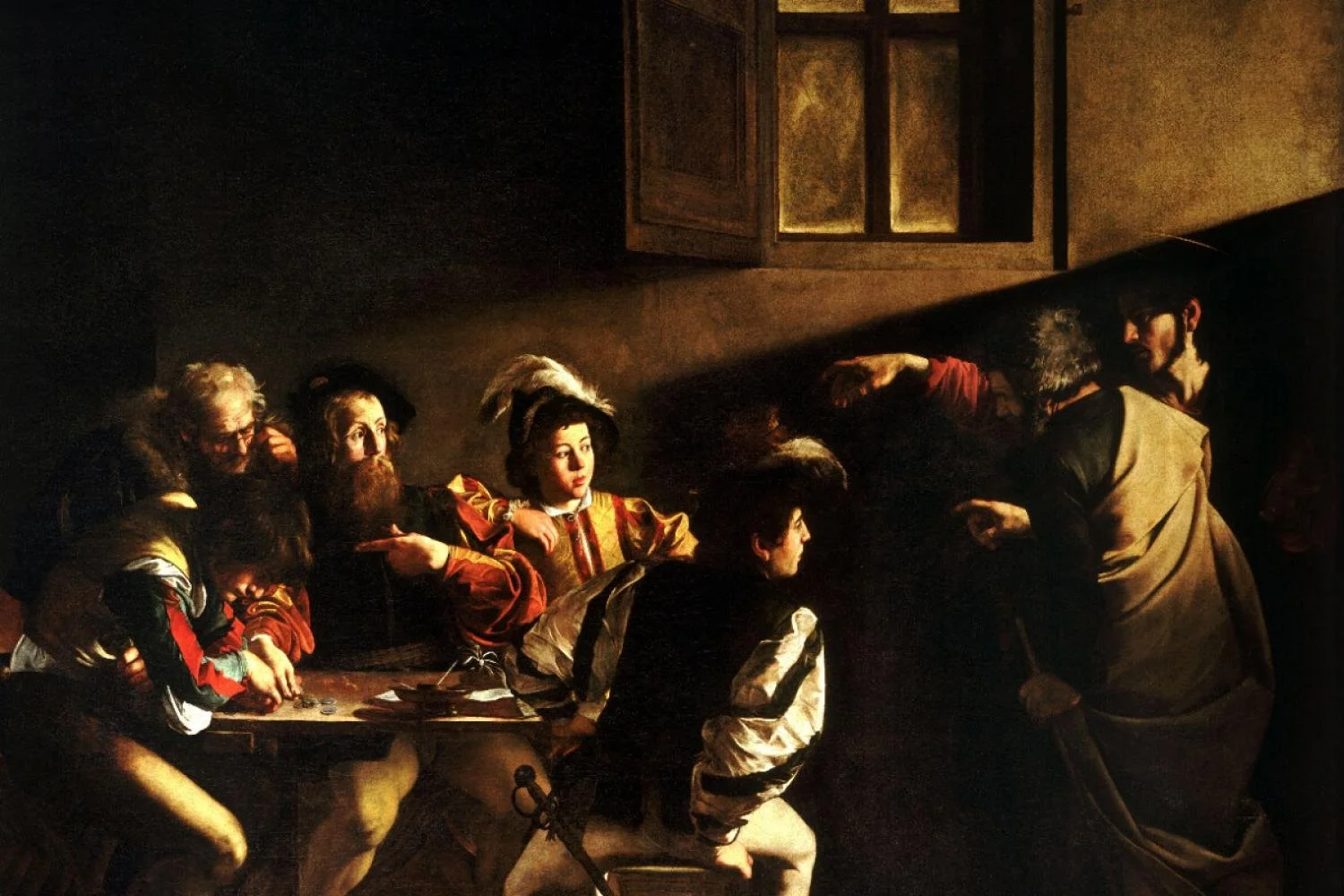
The Calling of Saint Matthew painting by Caravaggio hangs in the Contarelli Chapel in Rome. The painting shows a group of men siting around a table counting their money. On the far right, almost easy to miss, Jesus steps into the scene with Peter slightly in front of Him. Jesus doesn’t dominate the room. No halo glowing, no dramatic pose. Just a hand extended. And that hand matters. Caravaggio intentionally mirrors the hand of Adam from The Creation of Adam by Michelangelo. It’s subtle but powerful: the same God who gave life to Adam, and now the embodiment of the New Adam, is now calling Matthew into new life.
A single beam of light illuminates the darkness, pointing directly at Matthew. It represents grace. Also notice the light doesn’t come from the window, it comes from Christ. Grace enters the darkness and seeks him. And Matthew’s reaction is one of the most human moments in art. He points to himself as if to say, “Me?” That’s the heart of the painting.
Matthew is a tax collector, wealthy and comfortable, sitting there with coins in front of him, literally clinging to his old life. And yet when Christ calls, everything changes in a moment of decision. The painting freezes that instant, the split second between being who you were and becoming who God calls you to be.
An emerging theory worth pondering is that Matthew is in fact not the man with the beard pointing at himself, but instead the young man totally fixated on his money and his old way of life. We instead are only left to imagine the moment he glances up and his world is about to be changed forever.
Back to Simon Peter, a man of impulsive courage and restless heart, and his brother Andrew, steady and thoughtful, are ordinary men at the edge of the Sea of Galilee. They are fishermen. Bound to their nets. Bound to their routines. Bound to the rhythm of the water. Yet in that quiet moment, the extraordinary intrudes upon the ordinary. They are called to a destiny far greater than any catch of fish. Soon after, Jesus calls another set of brothers, James the Greater and John the Apostle. This set of brothers thought to be particularly passionate and maybe better characterized as fiery, were nicknamed by Jesus, Sons of Thunder. Sounds like a good pair to have in your crew to change the world. These brothers also fisherman, leave their boat. They leave their father. And they follow Jesus. This reminds us that Jesus does not call people because they are perfect. He calls them because He sees what they can become. Called to gather the scattered. Called to open eyes. Called to open hearts. Eventually, the group grows to twelve.
Simon Peter. Andrew. James the Greater. John the Apostle. Philip. Bartholomew.
Thomas. Matthew. James the Less. Thaddeus. Simon the Zealot. Judas Iscariot.
These twelve disciples would witness Jesus’ miracles. Hear His teachings. Walk with Him through the most important moments of His life. They would also struggle. Misunderstand Him. Sometimes fail. Yet Jesus chose them anyway. Why twelve? The number was not random. In the Old Testament, the people of Israel were formed from twelve tribes. By choosing twelve apostles, Jesus was showing that He was forming a new people of God. A new covenant family. A family that would one any spread throughout the world. These ordinary men would eventually become the foundation of the Church. After Jesus’ resurrection and the coming of the Holy Spirit, they would go out across the world, preaching the Gospel. The Church that exists today traces its roots back to these twelve men. Men who once heard a simple invitation: Follow me. The same voice that once called fishermen from their boats… Still calls every human heart today. Follow me