Course II
Human history had been preparing for this moment.
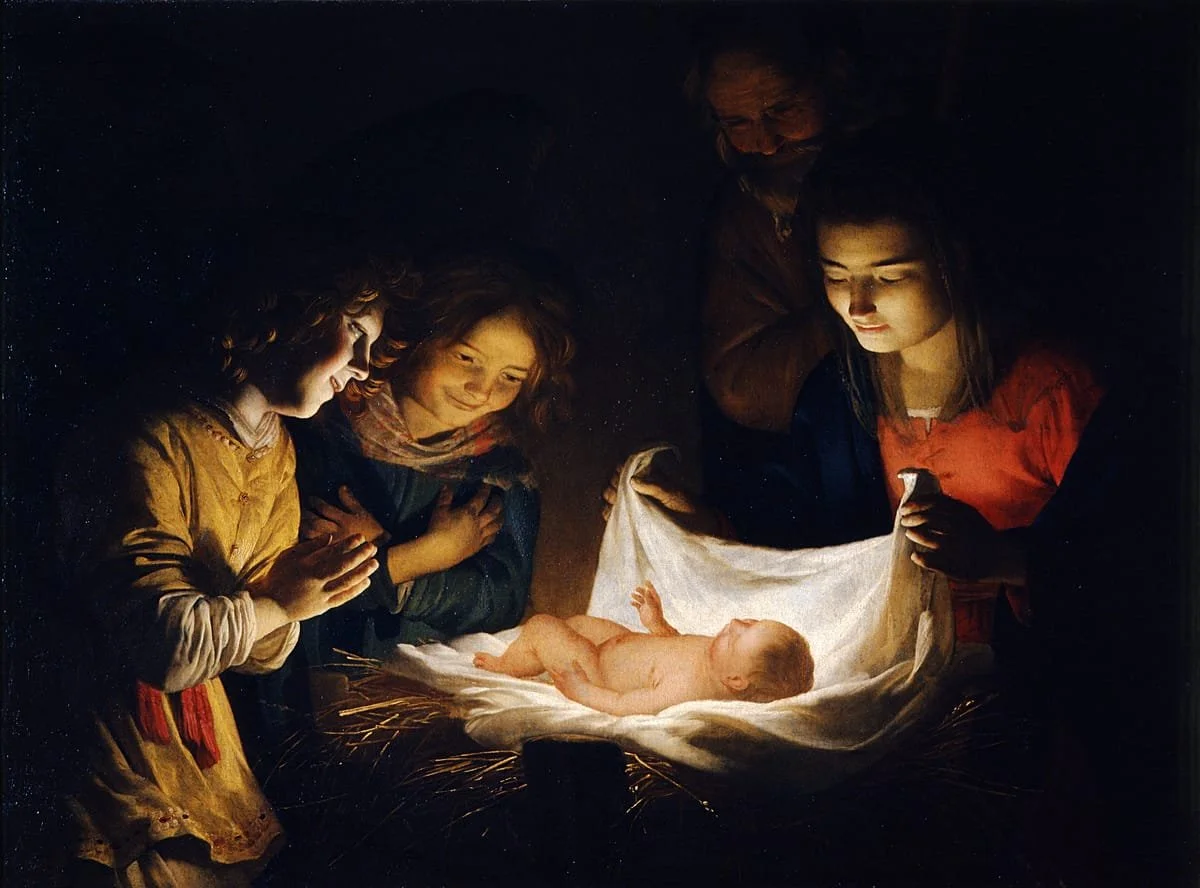
From the covenant with Abraham, to the law given through Moses, to the promises spoken through the prophets, God was slowly revealing His plan. Salvation history was unfolding step by step, generation by generation. And then, in a quiet corner of the Roman Empire, something unimaginable happened. A child was born. Not in a palace. Not surrounded by power. But in humility.
The infinite God accepted the limits of human life, hunger, fatigue, sorrow, friendship, joy. He entered fully into our experience. So, Christ assumed everything about our humanity in order to heal it. This is why the Incarnation matters so deeply. Incarnation meaning, God became man. In Mark’s Gospel it starts with the Greek word Euangelion, which is the “Good News.” This sounds like a standard greeting or introduction of the time, but this… this is a battle cry.
In the Roman Empire, the victories of the Emperor, Caesar Augustus, were proclaimed throughout the empire as Euangelion “good news.” Mark seizes that language and turns it on its head. He is declaring that the real victory did not come from Rome, but from a manger on the outskirts of the empire in Bethlehem.
One of the most striking patterns throughout Scripture is how God consistently takes what the world expects and turns it upside down. The Lord of all lords, the King of kings, didn’t arrive in splendor or majesty. He came quietly, unexpectedly, from a humble town where the shepherd boy, King David, was born a thousand years earlier. The Messiah entered the world not as a conquering hero, but as a baby, vulnerable and small. As C.S. Lewis so eloquently states, “Jesus entered the world so anonymously and clandestinely- as a baby born to insignificant parents in an out-of-the-way corner of the Roman Empire- because he was a warrior compelled to slip quietly behind enemy lines.”
A warrior needs an army and that is exactly the word used in Greek, stratia, or an ‘army’ of angels appeared to the Shepherds in the field. But notice who receives this momentous announcement. Not kings, not rabbis, not the powerful but shepherds. Men on the margins. Being a shepherd was humble, dirty work. A low-class job in society that requires you to spend most of your time outside with filthy animals. Shepherds though are prepared, in tune to the smallest shift or disturbance. Watchful. It was these shepherds who were first greeted but terrified at the site of an army of angels announcing the good news. They raced to the scene to worship and spread the announcement of the newborn king. The vigilant, the humble, the meek surround the Holy Family. Already, God is overturning expectations.
The Magi, so often portrayed in Nativity scenes, actually didn’t arrive until after the birth. These were most likely educated men or astronomers from the East, seekers, observers of the heavens, outsiders to Israel. And yet, they were drawn by a sign. As Pope Benedict XVI reflects in Jesus of Nazareth: The Infancy Narratives, they represent the nations beginning to stream toward Christ. Not just Israel, but the whole world is being gathered in. We are those Magi now, still and more true than ever, on our own journey.
And there is an even deeper possibility. Centuries before the birth of Christ, God was quietly at work in ways that spanned the nations. In the lands of the East, Daniel, a faithful Hebrew taken into exile in Babylon, rose to prominence as chief of the wise men, studying the heavens and the wisdom of the kingdoms around him. So, when the Magi observed the stars and began their journey, they may not have been searching blindly. They may have been waiting, guided by a tradition of wisdom preserved across generations. Waiting for a sign. Waiting for a king they did not yet know. If this is true, then their journey is not a sudden inspiration, but the fulfillment of a long preparation.
Even the manger itself is worth pausing over. The Son of God was laid not in a cradle, but in a feeding trough for animals. From the very beginning, there is a hint of what is to come: the One who will later give Himself as food for the life of the world enters humanity in a place of feeding. Because the Incarnation is not a myth floating above history. It is anchored in real places, real people, real tension, real time. It is, as Pope Benedict XVI insists, something that actually happened, yet it opens outward into a meaning that touches every age.
Eventually, this baby will become a man and stand before the Roman governor, Pontius Pilate, beaten, humiliated, crowned with thorns. Pilate presents Him to the crowd and declares: “Behold the man.” Ecce Homo. Pilate sees a defeated figure. A man stripped of power. But in God’s providence, the irony could not be more profound.
Here stands the true Man.
The new Adam.
Man as he was always meant to be.
When we look at Christ, we see not only who God is. We see who we were made to be. The Incarnation tells us three extraordinary things about God. First, God is not distant. He desires closeness with His creation. Second, our humanity has dignity. God considered it worthy enough to enter. Third, our story matters. God stepped into human history because our salvation mattered to Him. As Bishop Robert Barron often emphasizes, Christianity is not primarily an idea or philosophy. It is an event, something God actually did in the world.
God became one of us.
Enemy-occupied territory-that is what this world is. Christianity is the story of how the rightful king has landed, you might say landed in disguise, and is calling us to take part in a great campaign of sabotage
C.S. Lewis