
Course II
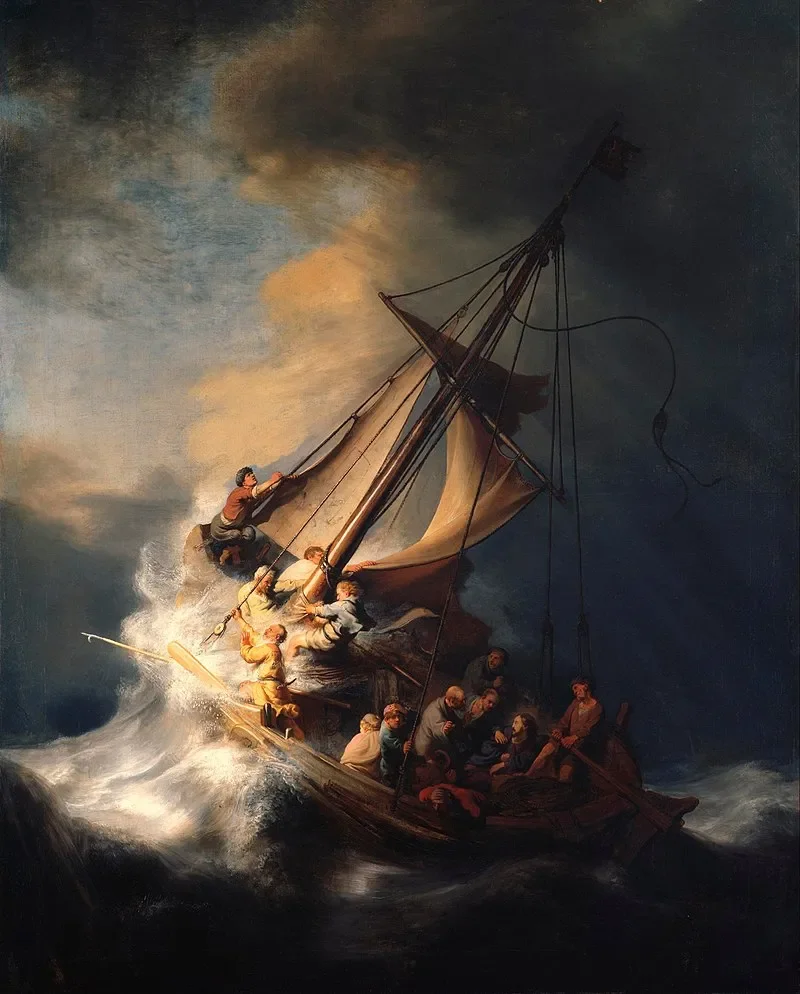
Jesus Calmed The Sea
Probably the most famous painting depicting Jesus’ miracles is The Storm on the Sea of Galilee by Rembrandt, painted in 1633. The painting depicts moments before Jesus calms the sea. As the disciples are depicted frantic and chaotic, the sails and ropes ripping away from their secure lines, Jesus is calm and un-wavered. Peaceful even. The light peaking through the sky is believed to be a nod to the eventual calming once Jesus commands it. One interesting note is; there is an extra person in the boat. The person looking outward back at the viewer, holding tightly to a rope, is believed to be a self portrait of Rembrandt himself. By placing himself in the boat Rembrandt in a way is inviting you to place yourself in the eye of the Storm with the disciples.
What’s fascinating is not just the painting itself, but its story. It was stolen in 1990 from the Isabella Stewart Gardner Museum, and it has never been recovered. Gone. An empty frame still hangs on the wall where it once was. We are left to wonder what exactly happened. Fitting.
“Everyone is looking for you.”
After Jesus performed miracles and taught, they could not find Him early in the morning. He had already gone out to be in solitude and pray. When they finally found Him, you can feel the apostles’ urgency, their excitement, “everyone is looking for you.” When you read the Gospels, it is easy to move quickly past the mentions of crowds and energy. But if you slow down, the scenes come alive. People crowded so closely to hear the word of God and be cured that Jesus had to ask His disciples to keep a boat ready so He would not be crushed. Huge crowds followed Him from every region. People even cut through the roof to lower their paralyzed friend down just to get him in front of Jesus because the crowds were so overwhelming. You can almost feel it, the urgency, the energy, the upheaval. What would cause such a stir?
Belief. Real belief that miracles were actually happening. Ask yourself, what would make you travel miles with limited transportation, limited money, and no guarantee of success, just for the chance to see Him, or even touch His garment? Yes, Jesus Christ taught in ways that were new, piercing, and unsettling, unlike anything they had heard before. But teaching alone does not make people leave their homes, abandon their routines, and travel miles in hope.
People across the centuries have tried to reduce these miracles to symbolism or storytelling. But to do that weakens the mission. Jesus was not just telling stories. He was reaching into our earthly reality and revealing that something greater exists. He was opening a window into a restored Kingdom.
His first miracle, the Wedding at Cana, turning water into wine at a wedding feast, is no small detail. A celebration. In the ancient world, wine symbolized divine life and joy. The message is clear, the time of fulfillment has begun. The feast has started. The diseased, especially lepers, were cut off from the community and from worship. Illness separated you not only physically, but spiritually. You were isolated. Jesus did the unthinkable. He restored them. He healed them. He brought them back into communion. Known members of the community, visibly transformed. Word spread quickly. As the crowds grew, they needed food. So Jesus fed them, miraculously, more than once. And all were satisfied. He encountered a man blind from birth. His disciples asked who had sinned. Jesus answered, neither, but that the works of God might be revealed. He made mud, placed it on the man’s eyes, and sent him to wash. The man returned seeing. The blind saw. The deaf heard. The lame walked. The sick were healed. Then something even greater.
He says, “Talitha koum,” little girl, I say to you, arise. And she rises. The dead were brought back to life. Not once, but multiple times. The accounts of the miracles of Jesus, like that stormy sea in the painting, leave us with a choice. To wonder. To reflect. And ultimately to decide, what do we believe?
A newly canonized modern day saint, Carlo Acutis, set out to show that miracles are not just events of the past. They are still present today. He created a website, miracolieucaristici.org, documenting Eucharistic miracles from around the world. Carlo was a normal teenager. He played video games. He lived an ordinary life. Then he was diagnosed with leukemia and died at the age of 15 in 2006. He believed his suffering could be offered as part of God’s greater plan. His final words to his mother were simple and profound.
“Mom, do not be afraid. Since Jesus became man, death has become a passage toward life. Let us prepare ourselves to experience something extraordinary in eternal life.”
That is belief.