
Course II
Along with the miracles, Jesus continued to teach.
Not in long lectures. Not in abstract philosophy. He taught in stories. Parables. Simple stories drawn from everyday life; seeds, shepherds, fishermen, vineyards, families. Stories that revealed truths far deeper than words alone could hold. While we could touch on many of them and each with their own rich interpretation, we are going to focus on a specific Parable to show the deeper meaning we can convey when pondering Jesus’ teaching. To do that we are going to unpack Henri Nouwen’s book The Return of the Prodigal son, as it is one of the most moving books I have ever read.
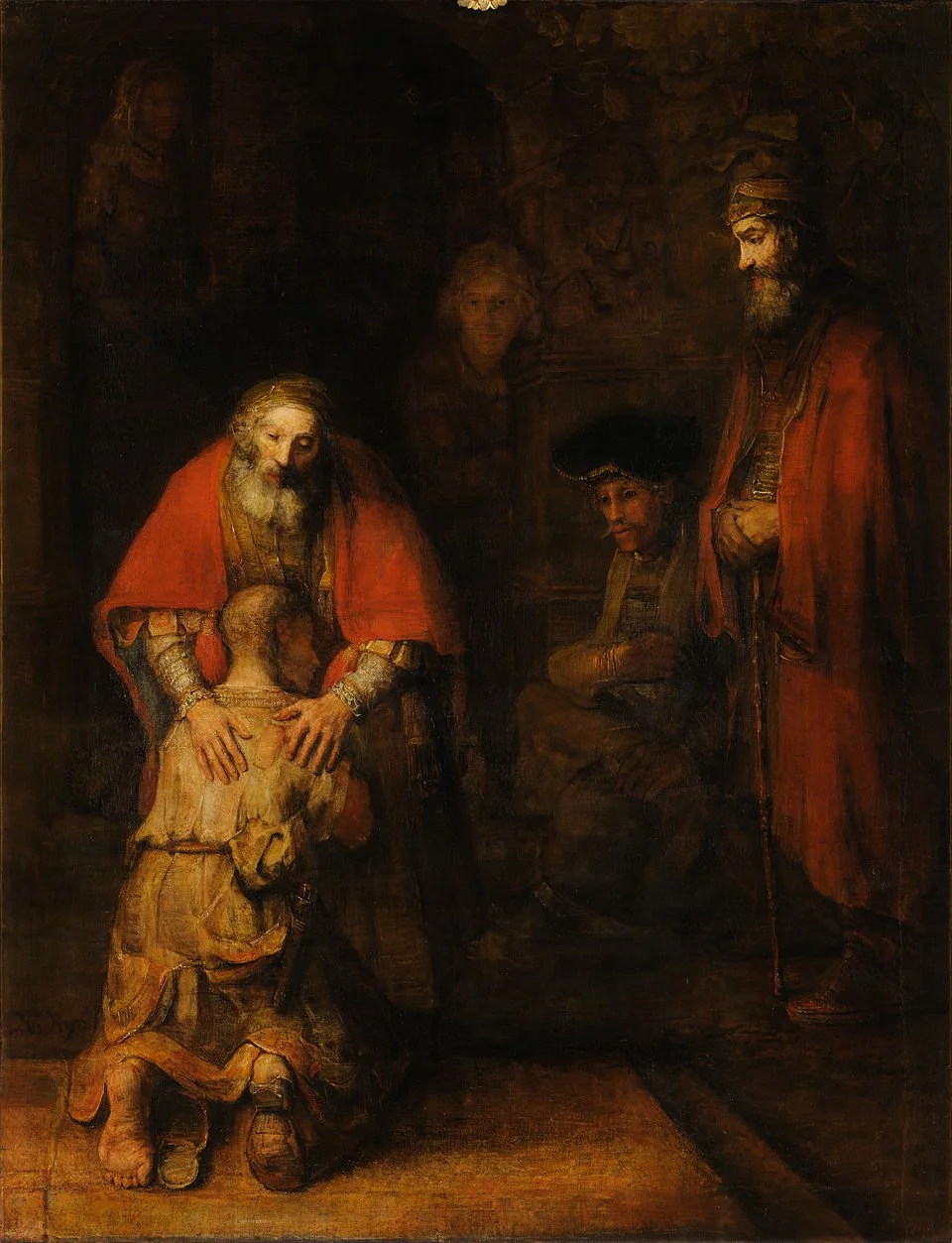
It tells the story of Henri Nouwen, a priest who while studying in France saw a poster of the painting depicting the The Return of the Prodigal Son and decided to travel to see the original art piece depicting the Parable. The Return of the Prodigal Son by Rembrandt is a painting from the 1600s and stands over eight feet tall. Nouwen would go to the Hermitage Museum, in Russia where it is displayed and for an entire week spent hours in front of the painting, all day even.
Over time, he began to reflect on the painting and the parable, drawing out layers of meaning that go far beyond what we might notice at first glance. The story itself may be familiar.
It begins with the younger son demanding his inheritance while his father is still alive, something deeply insulting in that culture, and honestly, would still be today. Yet the father grants it. The son leaves home and quickly squanders everything. Before long, he finds himself reduced to the lowest of circumstances, taking whatever work he can just to survive. And there, in that place of desperation, he is forced to make a choice.
Continue to live in despair or return home. He decides in anguish to return home, in complete embarrassment. As he is walking home from a far off distance, the father sees him, almost assuredly waiting for him. Before he can speak. Before the apology can be made. The Father runs to him. Something in ancient times would have been seen as unfitting. The Father embraces him. He gives him a robe. A ring. A feast. No lectures. No punishment. Just love. Overwhelming, unearned love.
That is usually where the listener focuses or knows of the story, as it is a beautiful story in itself. The wayward son that returns to the grace filled embrace from the Father. Yet there is another son, the elder son. Who stayed. Who worked. Who obeyed. We tend to forget about this part The father’s response to the elder Son when confronted is just as radical:
“All that I have is yours. But we must celebrate and be glad, because this brother of yours was dead and is alive again; he was lost and is found.”
What Nouwen conveyed from the story. We are all sometimes the younger son, hiding, as Adam and Eve first did after the Fall. Hiding from the Father, distancing themselves from the light. Squandering what we have been given, lost in our own choices. Expecting what we feel is rightfully ours. We are sometimes the elder son, obeying, working, yet closed to joy and mercy because we cannot forgive. Our appearance of good choices and order, truly a sign of our own ego. Our own calculated distortion of the faith. Self Serving in our hidden way, but cunning in thinking we have hidden it from the Father, and everyone.
The truth is, while we are at times both brothers, or know people that lived most of their lives as one brother as the other. But we are all called to be The Father. The exemplarily show of Mercy itself.
The story is a perfect example of God’s unrelenting, gracious love and our life’s pursuit to try to emulate it as best as our fallen nature will allow. And when we fail, and even run from this pursuit, when we realize this path is broken, he is there to celebrate our return home. And even if we appear to never leave the field from the outside world. The Father is calling us home just the same. Jesus taught these stories in this way to reveal truths. To invite us into it like a tug on a thread.
The medieval artists understood this well as they left their grand masterpieces of art open to interpretation and layered meaning. That is a Parable. The parables themselves show us that the kingdom of God in our broken world, is often upside down. And so by evidence of his meaning and mission is in fact the proper orientation. The prodigal son reminds us that God is always ready to welcome us home. The parables are not just stories to take at face value but always have layered meaning. They are invitations.
Rembrandt, the 17th century painter understood this deeper meaning well and Nouwen derived from the painting what he believed was Rembrandt’s subtleties.
First, there’s the younger son himself depicted in the painting. He’s completely worn down, shaved head, ragged clothes, one sandal missing. He looks almost like a beggar, not a son. Nouwen emphasizes how the son doesn’t even look up, he can’t yet meet the father’s eyes. It’s a posture of total surrender, maybe even shame. And yet the father doesn’t wait for an explanation, he simply embraces him.
The older brother stands off to the side, rigid and upright, almost in shadow. He’s well-dressed, composed, but distant. Nouwen points out that while the younger son is lost in rebellion, the older brother is lost in resentment. He’s physically close to the father, but emotionally far away.
Then the Father. First, the father’s hands. In The Return of the Prodigal Son, Henri Nouwen points out that the two hands resting on the son’s back are not the same. One is large and firm, almost masculine; the other is softer. Nouwen sees in this a symbol of God’s love as both strong and tender, just and merciful.
The father’s posture is another big one. He leans forward, almost straining toward the son. It’s not a distant, reserved welcome, it’s a full, eager movement of compassion. Nouwen sees this as God always leaning toward us, ready to receive us before we even finish our return.
And lastly the light. The entire painting is dark except for the father and the son. The light falls right on the place of mercy, almost as if to say this is where God’s heart is revealed most clearly, not in power or judgment, but in forgiveness.
“Behold, I stand at the door and knock. If anyone hears my voice and opens the door, I will come in to him and eat with him, and he with me".
-Revelation 3:20-
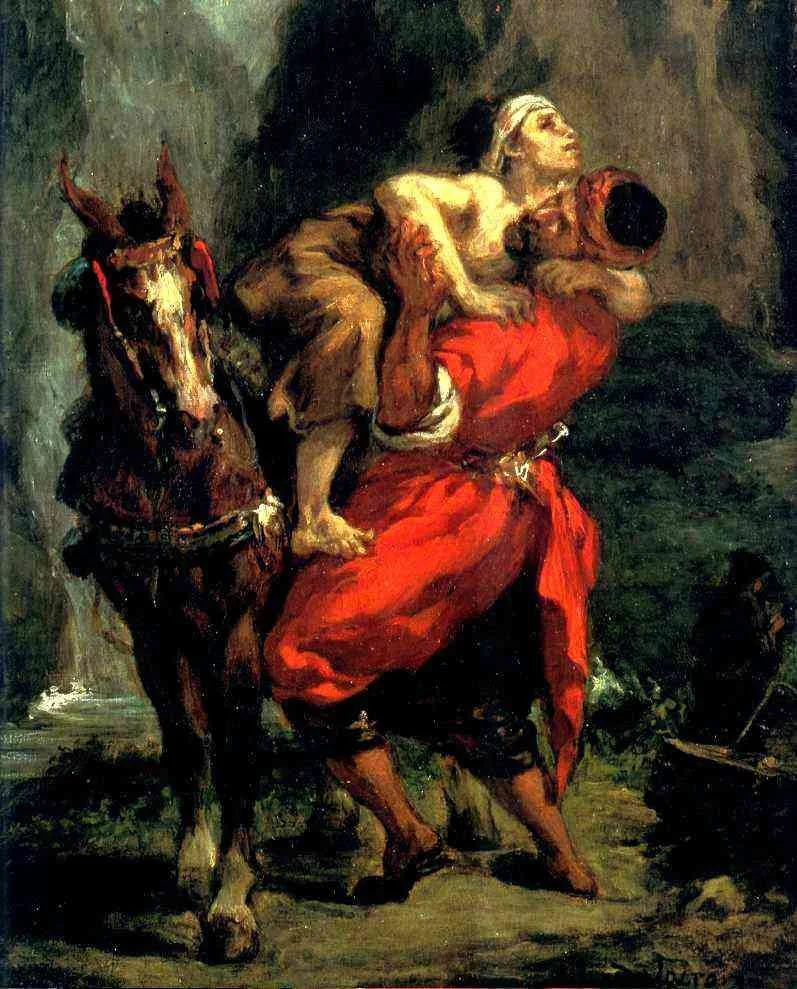
The Good Samaritan – Eugene Delacroix – 1849