
Course II
Jesus enters Jerusalem
Jesus had been coming to Jerusalem for Passover His entire life. From the very beginning, this city was part of His story. As a baby, He was carried into the Temple by Mary and Joseph for the Presentation. At twelve years old, He enters Passover seemingly with a large caravan of family and friends. This time, He stays behind. His parents search anxiously, and they find Him in the Temple, sitting among the teachers, listening, asking questions, amazing them with His understanding. And when they ask why He stayed, He responds, “Did you not know I must be in my Father’s house?” Year after year, He would have made this journey, walking the same dusty roads, singing the same psalms, entering the same gates as every other pilgrim.
This time, He doesn’t enter Jerusalem as one among thousands. He enters deliberately, publicly, fulfilling the words of the prophet Zechariah, riding on a donkey as a king. The same city that welcomed Him as an infant…The same Temple where He revealed His identity as a boy… Now receives Him as something more.
You can since the excitement, as a member of the crowd maybe someone in your family was healed by Jesus, or a friend had told you about being in a previous crowd during Jesus’ teachings, then off in the distance, the crowd recognizes him approaching. The masses are shouting and growing quickly. They begin to lay down palm branches. They start to cover the roads with cloaks. Voices rise:
Hosanna! Hosanna in the Highest!
Blessed is He who comes in the name of the Lord! And every step into Jerusalem is not just a step into the city, it is a step toward everything that was foretold from the very beginning. He enters the Temple, the very heart of Israel’s worship, and He cleanses it. This is not merely a moral correction, it is a prophetic sign. The Temple, the place of sacrifice, the meeting point between God and man, is being prepared for something new. Because Jesus Himself is becoming the true Temple. From there, the tension escalates. The leaders sense that something is slipping beyond their control. And so the machinery of betrayal begins to move. As Jesus enters Jerusalem, He is not just walking into a city, He is walking into His final Passover. And when Passover begins, He gathers with His closest friends for a meal. The Last Supper.
Remember that the central part of Passover was a meal. The prayers, the bread, the wine, the rhythm of the evening, all of it known. But this night is different. He takes the bread, blesses it, breaks it, and gives it to them saying, “This is my body.”
Then He takes the cup and says, “This is my blood, poured out for you.” The Passover, which had always been about remembering God delivering His people from Egypt, is now becoming something new. Not just a remembrance, but a participation. Not just a story of a lamb that was sacrificed long ago, but the reality that He is the Lamb. Before a single nail is driven, before the crowds gather, before the suffering begins, He gives Himself freely. And what makes it even more powerful is this, the apostles don’t fully understand. Peter will deny Him. Judas Iscariot has already set betrayal in motion. And yet, He still gives them His body and His blood.
The Last Supper is not just a farewell meal. It is the beginning of the sacrifice. After the Passover Meal Jesus moves to the nearby Garden And for the first time, we see the weight of what is coming press down on Him. He brings Peter, James, and John a little further in, and He tells them, “My soul is sorrowful, even to death.” Then He goes off alone to pray. And this is one of the most human moments in all of Scripture. He falls to the ground and says, “Father, if it is possible, let this cup pass from me… yet not my will, but yours be done.” This is not weakness. This is obedience at its deepest level.
He sees everything that is coming, the betrayal, the humiliation, the suffering, the cross, and He chooses it. Freely. Completely. While the disciples sleep, He wrestles in prayer. While they fail to stay awake, He remains faithful.
Moments later one of His own, Judas Iscariot, hands Him over. And notice the terrible irony: he does so with a kiss. In the Gospel, a kiss is a sign of intimacy, of love, and here it becomes the instrument of betrayal. Sin always involves this distortion, this twisting of the good. Jesus is arrested, and the disciples scatter. Peter the Apostle, the rock, denies Him three times. And we should not look at Peter from a distance, as though he were simply weak. Rather, we should recognize in him the pattern of our own lives, the bold promises, followed by fear; the desire for fidelity, followed by compromise.
Then comes the trial before Pontius Pilate. It is one of the most philosophically charged moments in all of Scripture. Pilate asks Jesus while prodding, “What is truth?” It is the question of every age, including our own. And here is the tragedy: Truth stands directly before Pilate. Yet Pilate cannot see. Instead, Pilate turns to the crowd. And here we witness the volatility of fallen humanity. The same voices that cried “Hosanna” now cry “Crucify him.” The crowd becomes a symbol of that restless energy within all of us, so easily swayed, so easily turned. And so Jesus is handed over. He is scourged, mocked, crowned with thorns. They dress Him as a king in cruel parody, not realizing that they are proclaiming a deeper truth than they intend.
A great painting, by Antonio Ciseri from the 19th century stands twelve feet tall, and sits in Florence, Italy today. The artwork took twenty years to paint. It depicts the next moment as if a photo was taken at the scene. It is worth pausing and reflecting on. Ciseri places the viewer backstage behind Pilate and Jesus. Instead of seeing the crowd perspective as is often portrayed, the view is as if you were a bystander to this immense moment. The elites surrounding Pilate and their varying expressions are worth meditating on themselves. Some seem to realize the injustice and humiliation displayed and portray confliction, but ultimately are too bound by their status, their own self-preservation to speak up. Pilate’s wife, is shown turning away, towards the viewer, as if she is in distress. Seemingly recognizing the innocence of Jesus but too powerless to do anything. We all in a way can relate to being the various bystander so often. Jesus’ posture is worth noting. Unlike many depictions, Jesus’ head is bowed and eyes closed. He is showing total surrender and inner peace amongst all the chaos that surrounds him. As if he was in the boat with the twelve during the storming sea at Galilee. His hands bound and wearing a scarlet Robe mocking his kingship. The balance of power is articulated with the grandness of the Roman structure, the colorful clothing of all those that surround Jesus. Then there is Pilate, gesturing almost exacerbated towards the crowd. Is this what you want? Here he is. Then Pilate in this moment says words echoed in eternity.
“Behold The Man”
Jesus is then condemned and led to carry the cross. The weight of our sins. We are seeing the Son who is perfectly obedient to the Father, entering fully into the suffering of the world. This is not a tragic accident. It is a willing offering. Here we come to the heart of it all. On the cross, Jesus is not simply enduring pain. He is performing a sacrifice. In the Old Testament, sacrifice was the way Israel expressed covenant, offering something back to God in love and obedience. But those sacrifices were always partial, always insufficient. Now, in Jesus, something utterly new is happening. The Son offers Himself to the Father, in perfect love, on behalf of the world.
This is why, even in the midst of agony, His words are not words of despair, but of surrender and mercy: “Father, forgive them.” The very people who reject Him become the recipients of His love. This is divine charity in its most radical form. And if we are honest, we must say: it is not just “they” who crucified Him. It is the whole weight of human sin, ours included, that He bears. The cross is not simply an event to observe; it is a mystery in which we are implicated.
In the Gospel of Luke, we are given a striking image of this mercy. A thief, a criminal, crucified alongside Jesus, a man who has lived a sinful and destructive life, rebukes the other criminal who mocks Jesus and his powers. Then, turning to Jesus in the midst of his suffering, says “Jesus, remember me in your Kingdom.” at which Jesus responds with the most consoling promise ever spoken: “Truly, I say to you, today you will be with me in Paradise.”
For what looks like defeat is, in fact, victory. Sin is met, not with retaliation, but with forgiveness. Violence is absorbed and transformed. Death itself is entered into, so that it might be undone from within. At last, Jesus breathes His last, and His body is laid in the tomb. The great silence descends. To all appearances, the story has ended in failure. But with God, silence is never empty. It is the space in which something new is about to emerge. And so we are left with a question, not simply about what happened then, but about what it means now. Will we remain in the crowd, moved by passing emotion? Will we stand at a distance, like Pilate, intrigued but uncommitted? Or will we follow this king to the cross, trusting that His way, however paradoxical, is the way to life? For in the Passion, we do not merely see what God has done. We see God as the Centurion did and exclaim “Surely he was the Son of God!” For God does not stand apart from suffering, but enters into it…and transforms it through love.
Where I am going you cannot come. I give you a new commandment, that you love one another. Just as I have loved you, you also should love one another.
John 13:33-34
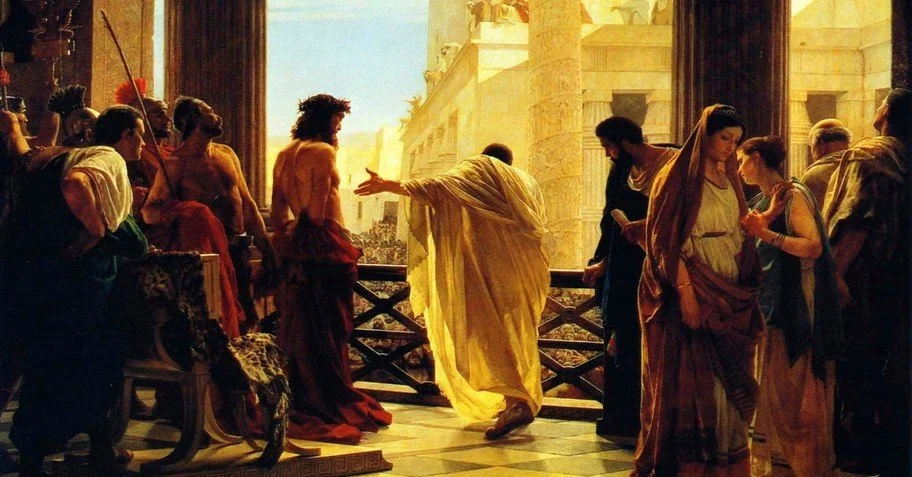
Ecce Homo - Behold The Man - Antonio Ceseri -1891