
Course IV
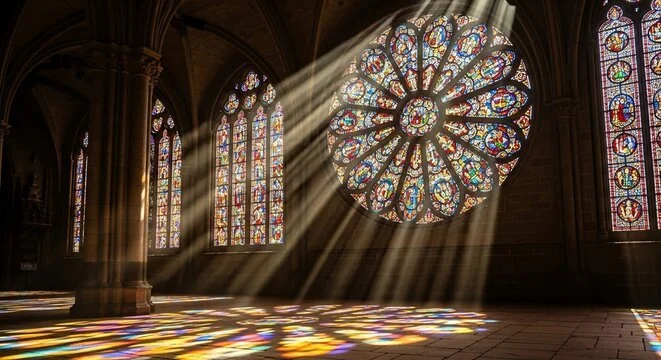
There’s a reason the great cathedrals of the world have rose windows.
There is something about beauty that is different from everything else we have talked about. Truth can be argued. But beauty… beauty is experienced. It is felt. It reaches us before we have the words for it. In the Catholic tradition, beauty is known as one of the transcendentals, along with truth and goodness. These are not just ideas, they are windows into God Himself. And beauty has a unique way of opening that window. Because beauty does not force its way in. It invites.
The rose windows, of Gothic cathedrals are the massive circular windows of stain glass depicting biblical narratives. They are usually located above the main western entrance, the north transept, or the south transept to catch direct sunlight and cast colorful light into the nave, the largest part of the Church. The circle shape representing the perfection and infinity of God. This nod, this display of light, speaks to something greater. The window itself creates in it a passage way to an array of colors and bright light.
You do not have to understand a beautiful thing to be moved by it. You do not have to explain it to feel it. A sunset, a piece of music, a painting, something in you recognizes it immediately. Almost as if your soul remembers where it came from. Think about the great works of art we have touched on. The Storm on the Sea of Galilee by Rembrandt, with its chaos and fear, yet Christ present in the boat. The Calling of Saint Matthew by Caravaggio, where light breaks into darkness and a life is changed forever.
These are not just masterpieces because of technique. They endure because they reveal something deeper. They point beyond themselves. The same is true of the great cathedrals. When you walk into a place like St. Peter’s Basilica or Notre-Dame Cathedral, you feel it immediately. The height, the light, the silence. Everything is designed to lift your eyes, and with them, your heart. Beauty, in this way, becomes a pathway to God. It bypasses our defenses. It slips past our distractions. It awakens something within us that says, there is more than this. There must be more than this. And that is why beauty matters so much. Because in a world that often feels loud, chaotic, and utilitarian, beauty reminds us that life is not just about function. It is about meaning. It is about wonder. It is about being drawn into something greater than ourselves. But here is the key, beauty also calls us out of ourselves.
This is why the Church has always cared so deeply about beauty, in her art, in her music, in her liturgy. Not as decoration, but as revelation. Beauty helps us see what words alone cannot express. It gives us a glimpse of heaven. And maybe that is why certain moments stay with us. A song that gives you chills. A painting you cannot stop looking at. A place that feels sacred the moment you enter it. You do not just observe it. You experience it. And in that experience, you are drawn closer to God. Now you may not be in a place that transcendent beauty is accessible, but in way our online access allows us to see and understand so much beauty at our fingertips. Any opportunity, however, in this digital age to get into nature, in the stillness and sounds of the woods, or under the stars are great ways to connect with the natural beauty around us. And then there is the ocean. Something about being at the edge of the sea, can feel as if creation itself is speaking without words. A reminder that there is something greater than you, something both unimaginably powerful, vast, yet beautiful. The Church has long understood this, that beauty is a pathway to God, a kind of silent invitation. It draws us in first. Let it draw you beyond yourself. Because beauty is not the end. It is the window. And through it, if we are willing to gaze in, we encounter God.
Begin with the beautiful, which leads you to the good, which leads you to the truth.
Hans Urs von Balthasar