
Course I
Now this story may feel familiar
but let’s walk through it with fresh eyes, as the significance beyond the surface level is critical to the overarching story of what is to come. The lessons unfold in four parts. Deliver Us, The Journey, The Ark of the Covenant, and The Promised Land. We want to keep the details somewhat to a minimum but make sure we understand the significance, as later on you will see these stories don’t just make good dramatic movie scenes but are the fabric of the faith.
Deliver Us From Evil
Deliver us means to be liberated, to be freed from evil. The twelve tribes of Israel are now in bondage in Egypt. Generations passed, and they remained enslaved. What began as a journey due to starvation became generational oppression. The descendants of Abraham were enslaved by the Egyptians and forced into hard labor. For years they cried out to God for help. And God answered by calling a man named Moses. Moses’ story begins in an extraordinary way. At a time when Hebrew children were being killed, he was rescued as a baby and raised in all places in the Pharaoh’s household itself. An unbelievable circumstance for a descendant of Israel. Yet despite growing up in the palace of Egypt, God chose him to lead His people out of slavery.
Now grown, one day while tending sheep in the wilderness, Moses saw something extraordinary: a bush on fire, yet not consumed. From that burning bush, God spoke to him. When Moses asked God His name, the Lord answered with words that would echo through history: “I AM WHO I AM.” In that moment God revealed something profound. He was not simply another god among many... but the one who is existence itself. This same God sent Moses, now fully knowing his Israelite identity, to confront Pharaoh and demand freedom for His people. But Pharaoh refused. Through Moses, God sent a series of plagues upon Egypt, each one demonstrating that the God of Israel was greater than the powers of Egypt. Then, finally came the last and most dramatic moment: the Passover. God instructed the Israelites to sacrifice a lamb and place the lamb’s blood above the doorposts of their homes. That night the angel of death passed through Egypt, but the homes marked by the blood of the lamb were spared. But there was another important instruction.
The people were not only to sacrifice the lamb; they were commanded to eat the lamb. This was essential, the sacrifice and the eating were both part of their obedience. This event became the great feast of Passover, remembered by the people of Israel for generations. Through the Passover, God delivered the Israelites from slavery and led them out of Egypt in what we now call the Exodus. This moment became one of the defining events of the Old Testament. God did not just rescue individuals; He rescued an entire people and began forming them into a nation. The climactic moment comes as Moses raises his staff to part the Red Sea to allow the Israelites to escape from the pursuing Egyptians. Symbolically, this passage through water through from captivity to freedom, foreshadows Baptism.
The Journey
After their escape from Egypt, the Israelites journeyed into the wilderness where God continued to guide and care for them. When the people grew hungry, God provided food from heaven called manna. Each morning, mysterious bread appeared on the ground, enough for the people to gather and eat for the day. Through this gift God taught them to trust Him daily for their needs. During their journey through the wilderness, God also brought the Israelites to Mount Sinai, where He established a new covenant with them and gave them the Law. The Law, or more commonly known as the Ten Commandments were meant to guide them in living as God’s people; a community built on faith, justice, and worship. That said, even during the waiting for Moses on Mount Sinai, the people grew tired and impatient, and built a large Golden Calf as something to worship. What Golden Calf do we build in our own lives?
The Ark of the Covenant
Many of us have heard the term, “Ark of the Covenant” I always heard of but never fully understood it. I remembered thinking, “Wait, was Noah involved, is there a piece of the Ark or Boat?” Maybe you never had this humorous confusion, but I think it is critically important we define the Ark of the Covenant actually was, and its importance and what it contained. The Ark was constructed out of acacia wood and covered in gold. It was carried on rods so no one could even touch it, it was thought to be so sacred. It was carried ahead of the Israelites in search of the Promised Land, and went before them, leading the people. What it contained is even more critical:
The stone tables of the Law (Ten Commandments)
A jar of manna (Bread from Heaven)
Aaron’s Staff (Miraculous and Symbol of Priesthood)
For this reason the Ark of the Covenant was the most sacred possession of the entire Israelite faith. It was the center of worship, and thanksgiving. It was an essence a portable throne representing God’s presence. It served as a symbol of the covenant of God and his people, the place of atonement for sins, and a guide in battle.
The Promised Land
For forty years the people of Israel journeyed to find the promised land, and a keynote that is worth reflecting on is…Moses himself would never enter it. He would never enter the Promised Land. So, after leading the people through the wilderness for forty years, Moses was allowed to see the Promised Land from a distance, but he would not step into it. Moses was the chosen leader, the one who confronted Pharaoh and led the people to freedom. Yet even he did not receive the final reward. There is something deeply meaningful in that. Sometimes the story God is writing is larger than one life. Moses’ mission was not to possess the Promised Land; it was to lead the people to its edge. In many ways our lives can be like that too. We may plant seeds that others will see grow. We may help build something whose full beauty we will never see in our lifetime. And that does not make our role smaller. It means we are part of something greater. Moses faithfully led God’s people to the threshold of the promise. And from there, the story only begins to unfold.
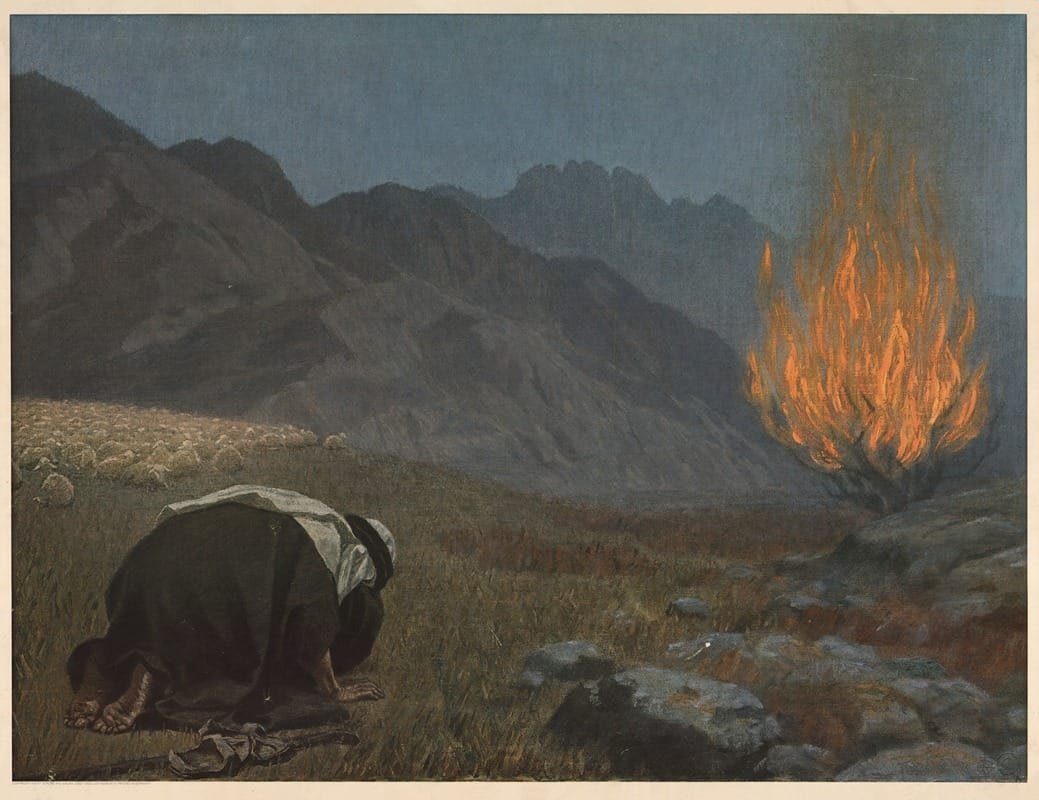
Burning Bush – Gebhard Fugel - 1932