Course V
“To go beyond the mind you have.”
That’s how this begins. The Greek word used in the Bible is metanoia. It’s often translated as “repent.” And over time, we’ve reduced that word to mean something small, feel bad, say sorry, move on. But that’s not what it means. When John the Baptist cried out in the wilderness, “Repent,” he wasn’t saying, “Just apologize.” He was saying: “Go beyond the mind you have.” Change the way you see. Change the way you think. Change the direction of your life. This is not behavior management. This is transformation. Because here’s the truth, every one of us carries things that are not of God. Habits. Attachments. Ways of thinking. Sin. And we don’t just do these things… over time, we begin to identify with them. “I’m just an angry person.” “I’m just lazy.” “I’m just not disciplined.” No. That’s not who you are. There is something deeper inside you. There is a lion inside you. And the first step is this: Remove what is not of God. Not manage it. Not excuse it. Remove it. Because you cannot become who you are meant to be while holding onto what is holding you back. But here’s the truth. The path forward will not be easy.
In a conversation with Jordan Peterson, a Navy SEAL was asked why he chose such a demanding path. He said it was the hardest thing he had ever done. Transformative. And the response from Petersen was simple: That’s the pathway. The pathway to what is real… is through the hardest thing you can do. Christianity does not offer an easier road. It offers a truer one. It doesn’t stop at removal. It moves to formation. It’s not just about what you eliminate…it’s about what you build. And this is where we come to a word we almost never use anymore. It sounds old.
It sounds medieval. It sounds like it belongs in stories about knights and quests. Virtue.
Virtue is not a personality trait. It’s not something you’re born with. Virtue is strength of soul. It’s who you become through repeated, intentional action. It’s choosing what is right, again and again, which builds new habits, until it becomes part of you.
The Church speaks of four foundational or Cardinal virtues. Temperance is the ability to govern yourself. Prudence is the ability to see clearly what is right. Justice is giving what is due, to others, and to God. Fortitude is the strength to do what is right, even when it’s hard. They are called the cardinal virtues because everything else hinges on them. They are a blueprint for becoming the kind of person your life actually depends on.
Additionally, the Theological Virtues of Faith, Hope, and Love can be critical to ponder where you stand on each one. I think even just a minute prior to Mass beginning or after receiving Communion is a great time to review these three. I think at times they can sound somewhat like nice pious reminders. They have become wall art for kitchens, and in doing so, somewhat feels over saturated but these are the heart of our journey. Faith, is the fuel to the flame, because all of our walk towards Christ should originate with a inner pronouncement of Faith, an internal yes. Which creates action. Hope is not a blind reliance on pure chance, but instead our intellect forming our reason to Hope accordingly. Hope that we eternal beings, and our Hope is in Jesus. Love, as discussed in our opening, to truly love, is to display self-sacrifice, and to will the good of the other. For that giving act for the other, is the heart of our imitation of Christ. As Paul says “And now these three remain: faith, hope and love. But the greatest of these is love.” Love is enduring, where when we are united with Christ in Heaven, Faith and Hope are no longer needed, but Love endures. It embodies our person, so we must try to seek that end, here and now.
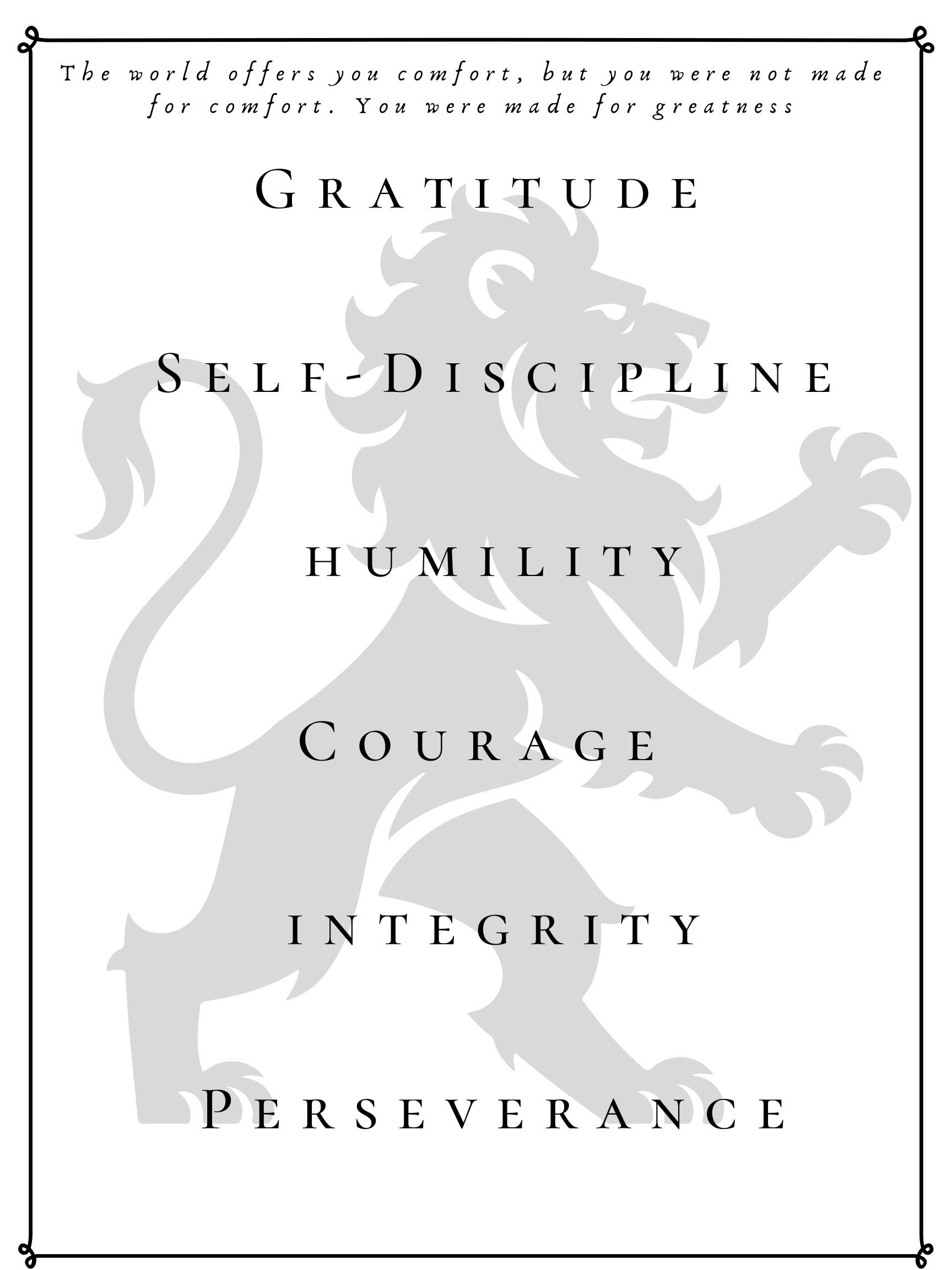
But knowing the virtues… is not the same as living them. A virtue path that can be a reminder for every day living that is worth displaying somewhere in your room, hallway or bathroom are the six virtues below. They fall within the Cardinal virtues and act as a reminder to seek virtue. At the end of the day or to start the day it is good to glance at them and question did I perform this well today? Where did I struggle?
Gratitude
The discipline to recognize that everything is gift. Starting with this mindset can set the tone for our entire day. Lack of being thankful, breeds entitlement and resentment
Self-Discipline
Doing what you are supposed to do, not what we want to do. So much of our daily struggles hinge on this. Discipline breeds discipline. Meaning discipline in all areas of your life, creates further gratification and desire in that discipline. We seek deep down to be rightly ordered, even though our feelings and wants try to pull us away from this order.
Humility
Not thinking less of yourself, but thinking of yourself less.
Courage
Choosing what is right even when it is hard or you’re scared. This does not have be some heroic act. Courage in the small moments are important moments.
Integrity
Being the same person in private, that you are in public.
Perseverance
Continuing forward when it would be easier to quit. Being willing to start again when we fail at the five virtues above.
These are not abstract ideas. These are weapons. Because every time you choose virtue, something changes. You are training your mind. You are strengthening your will. You are shaping your soul. You are becoming who you were created to be.
So often we focus on avoiding sin, but instead, seek virtue.
Your nature, your true nature, is not weakness. Every act of discipline. Every moment of courage. Every choice to do what is right. That is strength.